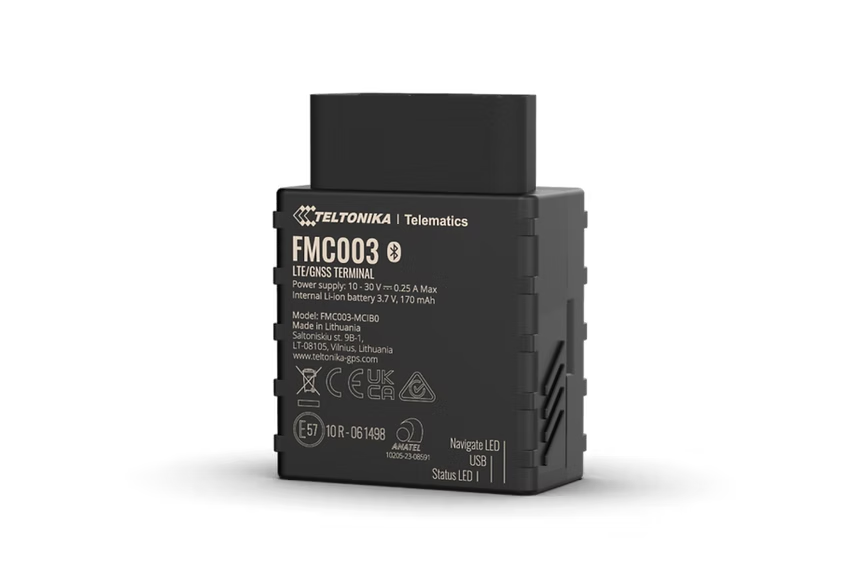
One small device. GPS tracking, driving behavior, and vehicle diagnostics — built in.
The FMC003 isn't just an OBD reader. It has built-in GPS, built-in 4G cellular, and a built-in accelerometer. That means it handles location tracking, driving behavior monitoring, and vehicle diagnostics all by itself.
Built-in GPS with 4G cellular. Real-time position, speed, and heading. Updates every 10-30 seconds depending on your plan. No phone needed — the device has its own satellite receiver and cellular modem. Accuracy under 2.5 meters.
Built-in 3-axis accelerometer detects harsh braking, rapid acceleration, and sharp turns. Records speed continuously. This is what enables safety scoring, teen driver monitoring, and driving behavior analysis — all without relying on a phone.
Full OBD-II data — diagnostic trouble codes, pending codes, freeze frames, coolant temp, battery voltage, RPM, fuel level, throttle position, engine load, intake air temp, odometer, and VIN. The same data your mechanic's $5,000 scan tool reads.
The FMC003 pulls 16 data points from your vehicle's onboard computer. This is the same data your mechanic sees when they plug in their scan tool.
Active fault codes
Early warnings
Snapshot at fault
Real-time revs
Engine temperature
12V system health
Tank percentage
Vehicle velocity
Pedal input %
Calculated load %
Air entering engine
Real OEM mileage
Auto-detected
On / Off state
Per-trip mileage
Real-time stream
No mechanic needed. No tools. No app pairing ritual. Literally plug it in and you're done.
Under the dashboard, driver side. Every car manufactured since 1996 has one. Usually below the steering wheel, sometimes behind a small cover.
Push the FMC003 into the OBD-II port until it clicks. Takes 10 seconds. The device powers itself from your car's electrical system — no separate battery, no charging cable.
The FMC003 connects over 4G automatically. No phone needed, no Bluetooth pairing, no WiFi. GPS location, driving data, and vehicle diagnostics start flowing to your dashboard within minutes.
For the people who want to know exactly what's inside the box.
| Constellations | GPS, GLONASS, Galileo, BeiDou, SBAS, QZSS |
| Channels | 33 tracking / 99 acquisition |
| Position Accuracy | <2.5m CEP |
| Hot Start | <1 second |
| Cold Start | <35 seconds |
| Technology | LTE Cat 1 |
| LTE FDD Bands | B1, B2, B3, B4, B5, B7, B8, B20, B28 |
| LTE TDD Bands | B40 |
| Fallback | 2G (GSM 850/900/1800/1900) |
| Speed | DL 10 Mbps / UL 5 Mbps |
| SMS | Supported |
| CAN | ISO 15765 |
| ISO | ISO 9141-2 |
| KWP2000 | ISO 14230 |
| SAE J1850 | PWM & VPW |
| Compatibility | All OBD-II protocols since 1996 |
| Power Source | OBD-II port (12V / 24V) |
| Standby Current | 0.003A |
| Operating Temp | -10°C to +55°C |
| Bluetooth | BLE 4.0 |
| Accelerometer | Built-in 3-axis (harsh braking, acceleration, cornering) |
Every vehicle manufactured since 1996 with an OBD-II port. Gasoline, diesel, hybrid, electric — doesn't matter.
Electric vehicle support covers 150+ models including Tesla, Chevrolet, Ford, BMW, Hyundai, Kia, Volkswagen, Rivian, and more. The device auto-detects your vehicle's VIN and configures itself to match the right OBD protocol.
If your car has that 16-pin trapezoid port under the dashboard, this works with it.
Most consumer OBD dongles use Bluetooth and rely on your phone for everything. Here's why the FMC003's built-in 4G modem is a fundamentally better approach for families.
| Capability | FMC003 (Built-In 4G) | Bluetooth OBD Dongle |
|---|---|---|
| Connectivity | Always on, 24/7 | Only when phone is nearby |
| GPS | Built-in satellite receiver (<2.5m) | Uses phone GPS (drains battery) |
| Teen monitoring | Can't be disabled by the driver | They just close the app |
| When parked | Still monitors (movement, ignition, geofence) | Only works when driving with phone |
| Position accuracy | <2.5m with multi-constellation GNSS | Depends on phone hardware |
| Phone dependency | None — works independently | 100% dependent on phone |